
WP1: Governance, Project Management, and Coordination
Duration: 01/12/2025 – 30/11/2028
Effective governance serves as the structural backbone of this transnational partnership. WP1 ensures the administrative rigor and financial stability required to synchronize activities across Italy, Romania, and Denmark, maintaining strict alignment with Erasmus+ compliance standards.
As the Lead Organisation, Giunone Soc. Coop. anchors the project’s financial flows and workflow coordination. Central to this governance are the Transnational Project Meetings (TPM) , which provide the essential forum for strategic quality control and pedagogical alignment. This robust administrative safety net allows the partnership to undertake the complex research and digital development tasks found in the subsequent Work Packages.
WP2: Research and Development of the Pedagogical Model
Duration: 01/01/2026 – 31/12/2026
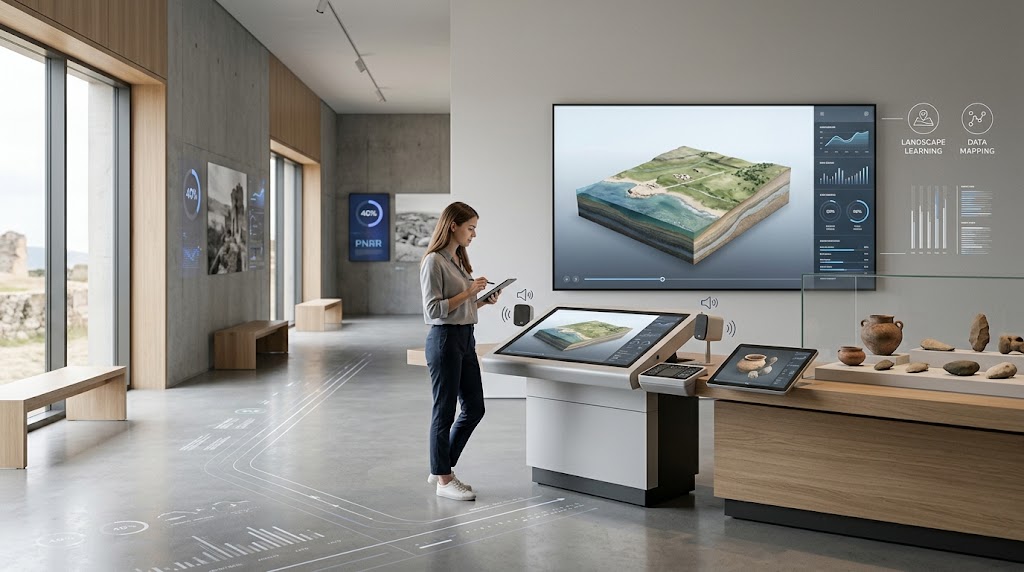
Innovation must be rooted in empirical evidence. WP2 focuses on mapping the current state of museum education, specifically addressing the Digital Divide —where nearly 40% of museum educators report a gap in technological preparation—and aligning with institutional mandates such as the MiC/ICCD 2026 Guidelines and the PNRR M1C3 investment framework.
The findings from WP2 directly dictate the technical specifications for Activity 2.2. The successful “Landscape Learning” approach necessitates 4D reconstructions to show landscape evolution over time. Furthermore, the “Embodied Cognition” identified in the Rosas Mine and ArcheoLab research requires the digital environment to incorporate spatialized 3D audio and haptic-ready 3D models to simulate the physical presence and sensory density of the original heritage sites.
WP3: Development of the Online Learning Space and Avatars
Duration: 01/01/2027 – 31/12/2027
WP3 represents the project’s most significant investment, shifting the pedagogical model into a multi-sensory digital ecosystem. Talent Garden Denmark leads the technical execution, focusing on inclusivity through high-fidelity digital tools.
Core Digital Activities
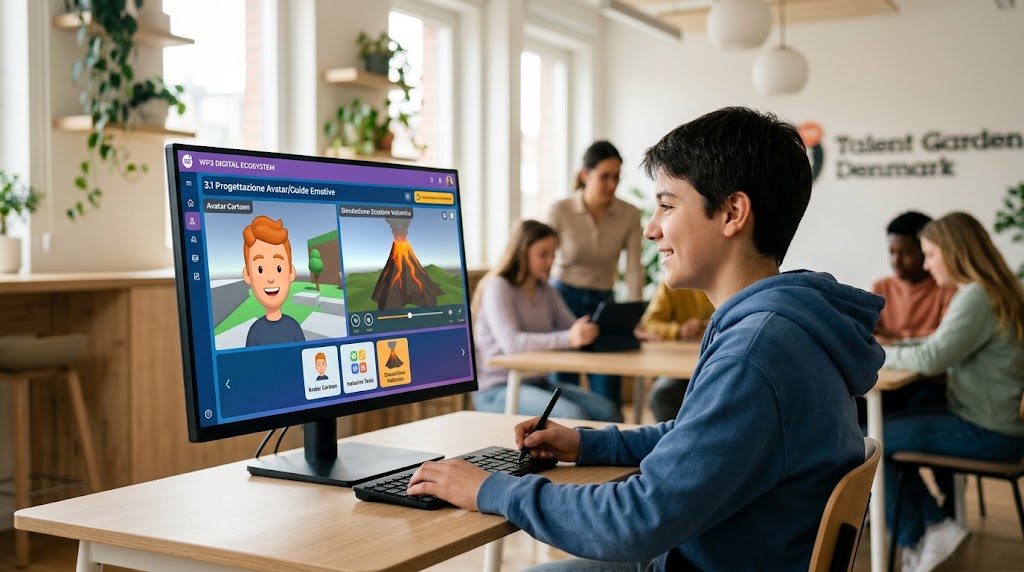
- Online Space/Avatar Design: Development of the “Avatar Cartoon” system. These avatars serve as “Emotive Guides” and “Expert Peers,” adapting their language to the student’s profile.
- Expert Validation: A rigorous quality gate involving pedagogical and technical specialists.
- Teaching Manual: The operational blueprint for educators to integrate these tools into school curricula.The “Avatar” system is critical for bridging the inclusion gap. By offering What-If scenarios and simulations, the digital space replicates the experimental nature of the Italian Best Practices (e.g., virtual pottery firing or volcanic eruption simulations), ensuring that digital tools are never mere substitutes but powerful “multipliers of reality.”
WP4: Experimentation, Pilot Testing, and Evaluation
Duration: 01/01/2028 – 31/10/2028
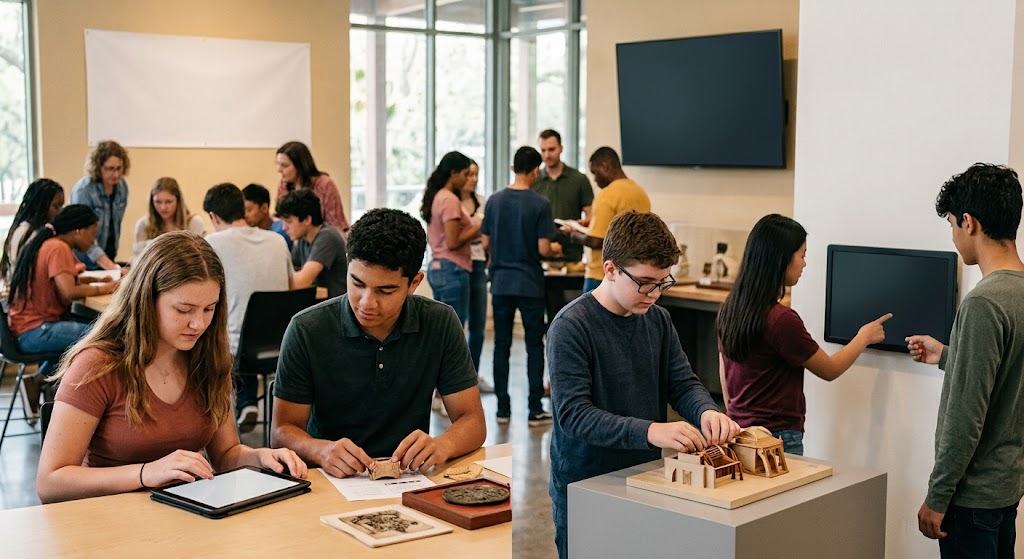
The “Field Validation” phase measures the impact of the MUSE-ACTIVE model on its primary beneficiaries. This experimentation transforms the theoretical framework into a proven methodology.
Success is evaluated via Activity 4.1 (Student Trials) and 4.2 (Data Evaluation) against specific benchmarks:
- Reach: Minimum of 60 participants per dissemination event and significant teacher/student trial clusters.
- Learning Gains: Pre- and post-test measurement of STEM and historical concept retention.
- Inclusion Equity: Accessibility scores for SEN students utilizing UDL 2.0 Specific inclusion tools to be tested include Easy-to-Read (ETR) materials using OpenDyslexic fonts, LIS (Sign Language) videos , and tactile 3D models to support learners with visual impairments. These trials provide the empirical weight needed for European-wide scaling.

WP5: Dissemination, Sustainability, and Long-Term Impact
Duration: 01/12/2025 – 30/11/2028
WP5 ensures that the project’s results outlive the funding cycle. The mandate is to move from immediate visibility to a lasting institutional network.
Communication Channels and Phased Strategy
Channel,Phase,Goal
Website & LinkedIn,Phase 1: Launch,Establish authority and announce the partnership.
Visual Content/Testimonials,Phase 2: Engagement,”””Behind-the-scenes”” of avatar creation and pilot trials.”
Academic/Press Pubs,Phase 3: Exploitation,Transfer results to the broader European educational community.